Forced Flows Correlations
Flat Plate
Profiles
Laminar Flow
Analytical: Smooth surface, no wall injection
\delta=\sqrt{\frac {280\nu x}{13U_{\infty}}}\approx4.64x\mathrm{Re}_x^{-1/2}\tag{5.2.15}
Analytical: Smooth surface, uniform heat flux with an adiabatic segment of length \xi, no wall injection, if T_s is the surface temperature
T_s-T_{\infty}=\frac {q_s''x}{0.453\mathrm{Re}_x^{1/2}\mathrm{Pr}^{1/3}k\left(1-\frac {\xi}x\right)^{-1/3}}\tag{5.4.23}
Turbulent Flow
Analytical: Smooth surface, no wall injection, if \delta and \delta_2 are the 0.99U_{\infty} boundary layer and momentum layer thickness
\begin{aligned} \delta & =0.37x\mathrm{Re}_x^{-0.2} \\ \delta_2 & =0.036x\mathrm{Re}_x^{-0.2} \end{aligned}\tag{5.2.36}
Friction Factor
Laminar Flow
Analytical: Smooth surface, no wall injection
C_f=0.646\mathrm{Re}_x^{-1/2}\tag{5.2.16}
Turbulent Flow
Analytical: Smooth surface, valid for \mathrm{Re}_x<10^6
C_f=0.0574\mathrm{Re}_x^{-0.2}\tag{5.2.38}
Schultz-Grunow (1941): Smooth surface, valid for \mathrm{Re}_x\geq5\times10^5
C_f=0.37\left(\log_{10}\mathrm{Re}_x\right)^{-2.584}\tag{5.2.39}
Heat Transfer Coefficient
Laminar Flow
Reynolds (1874): Smooth surface
\mathrm{Nu}_x=\frac 12\mathrm{Re}_xC_{f,x}\tag{9.2.10}
Analytical: Smooth surface, uniform wall temperature, no wall injection
\mathrm{Nu}_{x,\mathrm{UWT}}=0.3317\mathrm{Re}_x^{1/2}\mathrm{Pr}^{1/3}\tag{5.4.16}
Analytical: Smooth surface, uniform wall temperature with an adiabatic segment of length \xi, no wall injection
\mathrm{Nu}_{x,\mathrm{UWT}}=0.3317\mathrm{Re}_x^{1/2}\mathrm{Pr}^{1/3}\left[1-\left(\frac {\xi}x\right)^{3/4}\right]^{-1/3}\tag{5.4.19}
Analytical: Smooth surface, uniform heat flux with an adiabatic segment of length \xi, no wall injection
\mathrm{Nu}_{x,\mathrm{UHF}}=0.418\mathrm{Re}_x^{1/2}\mathrm{Pr}^{1/3}\left(1-\frac {\xi}x\right)^{-1/3}\tag{5.4.21}
Turbulent Flow
Analytical: Smooth surface, \frac 17 power law velocity and temperature profile, valid for \mathrm{Pr}\geq1, if \mathrm{St}_x=\frac {\mathrm{Nu}_x}{\mathrm{Re}_x\mathrm{Pr}}
\begin{aligned} \mathrm{St}_x\mathrm{Pr}^{0.4} & =\left.\frac {\mathrm{Nu}_x}{\mathrm{Re}_x\mathrm{Pr}}\right|_{\xi=0}\left[1-\left(\frac {\xi}x\right)^{9/10}\right]^{-1/9} \\ \left.\frac {\mathrm{Nu}_x}{\mathrm{Re}_x\mathrm{Pr}}\right|_{\xi=0} & =0.0287\mathrm{Re}_x^{-0.2} \end{aligned}\tag{5.4.27}
Prandtl-Taylor (1916): Smooth surface, \mathrm{Pr}=\mathrm{Pr}_{\mathrm{tu}}\approx1, viscous sublayer and fully turbulent sublayer in the boundary layer, laminar-like sublayers (viscous and buffer zone) extend to \delta_{\mathrm{lam}}^+=\frac {\delta_{\mathrm{lam}U_{\tau}}}{\nu}=5
\mathrm{Nu}_x=\frac {0.5C_f\mathrm{Re}_x\mathrm{Pr}}{1+5\sqrt{\frac {C_f}2}(\mathrm{Pr}-1)}\tag{9.3.9}
Prandtl-Taylor (1916): Smooth surface, \mathrm{Pr}=\mathrm{Pr}_{\mathrm{tu}}\approx1, viscous sublayer and fully turbulent sublayer in the boundary layer, laminar-like sublayers (viscous and buffer zone) extend to \delta_{\mathrm{lam}}^+=\frac {\delta_{\mathrm{lam}U_{\tau}}}{\nu}=9 (more realistic)
\mathrm{Nu}_x=\frac {0.029\mathrm{Re}_x^{0.8}\mathrm{Pr}}{1+1.525\mathrm{Re}_x^{-0.1}(\mathrm{Pr}-1)}\tag{9.3.13}
Von-Karman (1939): Smooth surface, valid for \mathrm{Pr}\lesssim40
\mathrm{Nu}_x=\frac {0.5C_f\mathrm{Re}_x\mathrm{Pr}\mathrm{Pr}_{\mathrm{tu}}^{-1}}{1+5\sqrt{\frac {C_f}2}\left(\mathrm{Pr}\mathrm{Pr}_{\mathrm{tu}}^{-1}-1+\ln\left[1+\frac 56\left(\mathrm{Pr}\mathrm{Pr}_{\mathrm{tu}}^{-1}-1\right)\right]\right)}\tag{9.4.9}
Mass Transfer
Turbulent Flow
Reynolds (1874): Smooth surface, if \mathrm{Sh}_x=\frac {\mathfrak K_x}{\rho\mathfrak D_{12}} where \mathfrak D_{12} is the diffusivity of the transferred species in the mixture
\mathrm{Sh}_x=\frac 12\mathrm{Re}_x\mathrm{Sc}\tag{9.2.13}
Prandtl-Taylor (1916): Smooth surface, \mathrm{Pr}=\mathrm{Pr}_{\mathrm{tu}}\approx1, boundary layer composed of viscous sublayer and fully turbulent layer, laminar-like sublayers (viscous and buffer zone) extend to \delta_{\mathrm{lam}}^+=\frac {\delta_{\mathrm{lam}U_{\tau}}}{\nu}=5
\mathrm{Sh}_x=\frac {0.5C_f\mathrm{Re}_x\mathrm{Sc}}{1+5\sqrt{\frac {C_f}2}(\mathrm{Sc}-1)}\tag{9.3.10}
Prandtl-Taylor (1916): Smooth surface, \mathrm{Pr}=\mathrm{Pr}_{\mathrm{tu}}\approx1, viscous sublayer and fully turbulent sublayer in the boundary layer, laminar-like sublayers (viscous and buffer zone) extend to \delta_{\mathrm{lam}}^+=\frac {\delta_{\mathrm{lam}U_{\tau}}}{\nu}=9 (more realistic)
\mathrm{Sh}_x=\frac {0.029\mathrm{Re}_x^{0.8}\mathrm{Sc}}{1+1.525\mathrm{Re}_x^{-0.1}(\mathrm{Sc}-1)}\tag{9.3.14}
von-Karman (1939): Smooth surface, valid for \mathrm{Sc}\lesssim40
\mathrm{Sh}_x=\frac {0.5C_f\mathrm{Re}_x\mathrm{Sc}\mathrm{Sc}_{\mathrm{tu}}^{-1}}{1+5\sqrt{\frac {C_f}2}\left(\mathrm{Sc}\mathrm{Sc}_{\mathrm{tu}}^{-1}-1+\ln\left[1+\frac 56\left(\mathrm{Sc}\mathrm{Sc}_{\mathrm{tu}}^{-1}-1\right)\right]\right)}\tag{9.4.9}
Circular Channel
Laminar:
\mathrm{Re}_D\lesssim2100
Transition:
2100<\mathrm{Re}_D<10^4
Turbulent:
\mathrm{Re}_D>10^4
Entrance Lengths
Laminar Flow
Chen (1973): Smooth surface
\frac {l_{\mathrm{ent,hy}}}D=\frac {0.60}{0.035\mathrm{Re}_D+1}+0.056\mathrm{Re}_D\tag{4.2.12}
Analytical: Smooth surface
\frac {l_{\mathrm{ent,th}}}D\approx0.05\mathrm{Re}_D\mathrm{Pr}\tag{4.5.30}
Turbulent Flow
Experimental: For \mathrm{Pr}\approx1 or \mathrm{Sc}\approx1 fluids
\begin{aligned} \frac {l_{\mathrm{ent,hy}}}D & \approx10 \\ \frac {l_{\mathrm{ent,th}}}D & \approx10 \\ \frac {l_{\mathrm{ent,ma}}}D & \approx10 \end{aligned}\tag{7.1.4}
Wang (1982): Smooth surface, flat inlet velocity profile, \frac 17 power law velocity profile
\frac {l_{\mathrm{ent,hy}}}D=1.3590\mathrm{Re}_D^{1/4}\tag{7.2.3}
Fully Developed Flow
Profiles
Laminar Flow
Hagen-Poiseuille (1840): Smooth surface
\begin{aligned} u(r) & =2U_m\left[1-\left(\frac r{R_0}\right)^2\right] \\ U_m & =\frac {R_0^2}{8\mu}\left(-\frac {\mathrm dP}{\mathrm dx}\right) \end{aligned}\tag{4.3.2}
Turbulent Flow
Wang (1982): Smooth surface, flat inlet velocity profile, \frac 17 power law velocity profile
\frac {x/D}{\mathrm{Re}_D^{1/4}}=1.4039\left(\frac {\delta}{R_0}\right)^{5/4}\left[1+0.1577\left(\frac {\delta}{R_0}\right)-0.1793\left(\frac {\delta}{R_0}\right)^2-0.0168\left(\frac {\delta}{R_0}\right)^3+0.0064\left(\frac {\delta}{R_0}\right)^4\right]\tag{7.2.2}
Nikuradse (1932): Smooth surface, n power law velocity profile, valid for y^+>30
\begin{aligned} \frac {\overline u}{U_{\mathrm{max}}} & =\left(\frac y{R_0}\right)^{1/n} \\ \frac {U_m}{U_{\mathrm{max}}} & =\frac {2n^2}{(n+1)(2n+1)} \end{aligned}\tag{7.2.6}
where
| \mathrm{Re}_D | 4000 | 2.3\times10^3 | 1.1\times10^5 | 1.1\times10^6 | 2.0\times10^6 | 3.2\times10^6 |
|---|---|---|---|---|---|---|
| n | 6 | 6.6 | 7 | 8.8 | 10 | 10 |
Prandtl (1933): Smooth surface, valid for y^+>30
\frac {U_{\mathrm{max}}-\overline u}{U_{\tau}}=2.5\ln\left(\frac {R_0}y\right)\tag{7.2.8}
Wang (1946): Smooth surface
\frac {U_{\mathrm{max}}-\overline u}{2.5U_{\tau}}=\ln\left(\frac {1+\sqrt{1-\frac y{R_0}}}{1-\sqrt{1-\frac y{R_0}}}\right)-2\arctan\sqrt{1-\frac y{R_0}}-0.572\ln\left(\frac {2.53-\frac y{R_0}+1.75\sqrt{1-\frac y{R_0}}}{2.53-\frac y{R_0}-1.75\sqrt{1-\frac y{R_0}}}\right)+1.143\arctan\left(\frac {1.75\sqrt{1-\frac y{R_0}}}{0.53+\frac y{R_0}}\right)\tag{7.2.9}
Yu et al. (2001): Smooth surface, valid for 150<R_0^+<50,000 where R_0^+=\frac {U_{\tau}R_0}{\nu} and U_{\tau}=\sqrt{\frac {\tau_s}{\rho}}
U_m^+=3.2-\frac {227}{R_0^+}+\left(\frac {50}{R_0^+}\right)^2+\frac 1{0.436}\ln R_0^+\tag{7.2.34}
Yu et al. (2001): Smooth surface, valid for R_0^+>500 where R_0^+=\frac {U_{\tau}R_0}{\nu} and U_{\tau}=\sqrt{\frac {\tau_s}{\rho}}
U_{\mathrm{CL}}^+=7.52+\frac 1{0.436}\ln R_0^+
White (2006): Smooth surface, \kappa=0.4 and B=5.5, valid for R_0^+>30
U_m^+=\frac 1{\kappa}\ln R_0^++B-\frac 3{2\kappa}
Friction Factor
Laminar Flow
Hagen-Poiseuille (1840): Smooth surface
f=4C_f=\frac {64}{\mathrm{Re}_D}\tag{4.3.7}
Shah and London (1978): Smooth surface, valid for all x^*=\frac x{D\mathrm{Re}_D} range
C_{f,\mathrm{app},x}\mathrm{Re}_D=\frac {3.44}{\sqrt{x^*}}+\frac 1{1+2.1\times10^{-4}\left(x^*\right)^{-2}}\left(\frac {1.25}{4x^*}+16-\frac {3.44}{\sqrt{x^*}}\right)\tag{4.2.13}
Turbulent Flow
Wang (1982): Smooth surface, flat inlet velocity profile, \frac 17 power law velocity profile
C_{f,\mathrm{app},x}\mathrm{Re}_D^{1/4}=\frac {(U_{\mathrm{max}}/U_m)^2-1}{4x/\left(4x\mathrm{Re}_D^{1/4}\right)}\tag{7.2.4}
where
\frac {U_m}{U_{\mathrm{max}}}=1-\frac 14\left(\frac {\delta}{R_0}\right)+\frac 1{15}\left(\frac {\delta}{R_0}\right)^2\tag{7.2.5}
White (2006): Smooth surface, valid for all R_0^+=\frac {U_{\tau}R_0}{\nu} where U_{\tau}=\sqrt{\frac {\tau_s}{\rho}}
\frac 1{\sqrt{C_f}}=1.7272\ln\left(\mathrm{Re}_D\sqrt{C_f}\right)-0.395\tag{7.2.37}
Blasius (1913): Smooth surface, \frac 17 power law velocity profile, valid for \mathrm{Re}_D\lesssim10^5
C_f=0.079\mathrm{Re}_D^{-1/4}\tag{7.2.38}
White (2006): Fully rough surface
\frac 1{\sqrt f}=2.0\log_{10}\left(\frac {\mathrm{Re}_D\sqrt f}{1+0.1\mathrm{Re}_D\sqrt f\varepsilon_s/D}\right)-0.8\tag{7.2.40}
Colebrook (1939): Fully rough surface, valid for 5\leq\varepsilon_s^+\leq70
\frac 1{\sqrt f}=-2.0\log_{10}\left(\frac {\varepsilon_s/D}{3.7}+\frac {2.51}{\mathrm{Re}_D\sqrt f}\right)\tag{7.2.41}
Haaland (1983): Fully rough surface
\frac 1{\sqrt f}=-1.8\log_{10}\left[\left(\frac {\varepsilon_s/D}{3.7}\right)^{1.11}+\frac {6.9}{\mathrm{Re}_D}\right]\tag{7.2.42}
Heat Transfer Coefficient
Laminar Flow
Analytical: Smooth surface, negligible axial conduction, negligible viscous dissipation
\mathrm{Nu}_{D,\mathrm{UHF}}=\frac {48}{11}\approx4.364\tag{4.4.6}
Shah and London (1978): With viscous dissipation and volumetric energy generation, if q_v^*=\frac {\dot q_vD}{q_s''} and \mathrm{Br}'=\frac {\mu U_m^2}{q_s'' D}
\mathrm{Nu}_{D,\mathrm{UHF}}=\frac {48}{11}\frac 1{1+\frac 3{44}q_v^*+\frac {48}{11}\mathrm{Br}'}\tag{4.4.9}
Analytical: Smooth surface, negligible axial conduction, if \lambda_0=2.70436442
\mathrm{Nu}_{D,\mathrm{UWT}}=\frac {\lambda_0^2}2=3.6568\tag{4.4.22}
Analytical: Smooth surface, negligible axial conduction, negligible viscous dissipation, if x^*=\frac x{D\mathrm{Re}\mathrm{Pr}}>0.0335, temperature profile is
\frac {T_m-T_s}{T_{\mathrm{in}}-T_s}=0.81905\exp\left(-2\lambda_0^2x^*\right)\tag{4.4.23}
Michelsen and Villadsen (1974): Smooth surface, axial conduction, if \mathrm{Pe}=\mathrm{Re}_D\mathrm{Pr}
\mathrm{Nu}_{D,\mathrm{UWT}}=\begin{cases} 3.6568\left(1+\frac {1.227}{\mathrm{Pe}^2}+\cdots\right) & \qquad\qquad\mathrm{Pe}>5 \\ 4.1807(1-0.0439\mathrm{Pe}+\cdots) & \qquad\qquad\mathrm{Pe}<1.55 \end{cases}
Turbulent Flow
Norris (1970): Rough surfacess (accounted for in C_f)
\frac {\mathrm{Nu}_{D_H}}{\mathrm{Nu}_{D_H,\mathrm{smooth}}}=\min\left[\left(\frac {C_f}{C_{f,\mathrm{smooth}}}\right)^n,4^n\right]\tag{7.1.1}
where
n=\begin{cases} 0.68\mathrm{Pr}^{0.215} & \qquad\qquad\mathrm{Pr}<6 \\\\ 1 & \qquad\qquad\mathrm{Pr}>6 \end{cases}\tag{7.1.2}
Yu et al. (2001): Smooth surface, all thermal boundary conditions, valid for R_0^+>500 and \mathrm{Pr}>\mathrm{Pr}_{\mathrm{tu}}
\begin{aligned} \mathrm{Nu}_{D_H} & =\frac 1{\frac 1{\mathrm{Nu}_{D_H,1}}\frac {\mathrm{Pr}_{\mathrm{tu}}}{\mathrm{Pr}}+\frac 1{\mathrm{Nu}_{D_H,\infty}}\left[1-\left(\frac {\mathrm{Pr}_{\mathrm{tu}}}{\mathrm{Pr}}\right)^{2/3}\right]} \\ \mathrm{Nu}_{D_H,\infty} & =0.07343\mathrm{Re}_{D_H}\left(\frac {\mathrm{Pr}}{\mathrm{Pr}_{\mathrm{tu}}}\right)^{1/3}\left(\frac {C_f}2\right)^{1/2} \\ \mathrm{Pr}_{\mathrm{tu}} & =0.85+0.015\mathrm{Pr}^{-1} \end{aligned}\tag{9.6.6}
For uniform wall temperature or uniform heat flux boundaries, \mathrm{Nu}_{D_H,1} is
\begin{aligned} \mathrm{Nu}_{D_H,1,\mathrm{UWT}} & =\frac {\mathrm{Re}_{D_H}C_f/2}{1+145\left(U_m^+\right)^{-2/5}} \\ \mathrm{Nu}_{D_H,1,\mathrm{UHF}} & =\frac {\mathrm{Re}_{D_H}C_f/2}{1+195\left(U_m^+\right)^{-2.7}} \end{aligned}\tag{9.6.9}
For the dimensionless mean velocity, U_m^+, see Yu et al. (2001)’s correlation in Sec. 2.2.1.2.
Chilton and Colburn (1934): Smooth surface, valid for 10^4<\mathrm{Re}_D<3\times10^5 and 0.6<\mathrm{Pr}<100
j_{\mathrm{th}}=\mathrm{St}\mathrm{Pr}^{2/3}=\frac {\mathrm{Nu}_l}{\mathrm{Re}_l\mathrm{Pr}^{1/3}}=\frac {C_f}2\tag{9.7.8}
Prandtl-Taylor (1916): Smooth surface, \mathrm{Pr}=\mathrm{Pr}_{\mathrm{tu}}\approx1, viscous sublayer and fully turbulent sublayer in the boundary layer, laminar-like sublayers (viscous and buffer zone) extend to \delta_{\mathrm{lam}}^+=\frac {\delta_{\mathrm{lam}U_{\tau}}}{\nu}=5
\mathrm{Nu}_x=\frac {0.5C_f\mathrm{Re}_x\mathrm{Pr}}{1+5\sqrt{\frac {C_f}2}(\mathrm{Pr}-1)}\tag{9.3.9}
Prandtl-Taylor (1916): Smooth surface, \mathrm{Pr}=\mathrm{Pr}_{\mathrm{tu}}\approx1, viscous sublayer and fully turbulent sublayer in the boundary layer, laminar-like sublayers (viscous and buffer zone) extend to \delta_{\mathrm{lam}}^+=\frac {\delta_{\mathrm{lam}U_{\tau}}}{\nu}=9 (more realistic)
\mathrm{Nu}_x=\frac {0.029\mathrm{Re}_x^{0.8}\mathrm{Pr}}{1+1.525\mathrm{Re}_x^{-0.1}(\mathrm{Pr}-1)}\tag{9.3.13}
von-Karman (1939): Smooth surface, valid for \mathrm{Pr}\lesssim40
\mathrm{Nu}_x=\frac {0.5f\mathrm{Re}_{D_H}\mathrm{Pr}\mathrm{Pr}_{\mathrm{tu}}^{-1}}{1+5\sqrt{\frac {C_f}2}\left\{\left(\mathrm{Pr}\mathrm{Pr}_{\mathrm{tu}}^{-1}-1\right)+\ln\left[1+\frac 56\left(\mathrm{Pr}\mathrm{Pr}_{\mathrm{tu}}^{-1}-1\right)\right]\right\}}\tag{9.4.9}
Mass Transfer
Turbulent Flow
Chilton and Colburn (1934): Smooth surface, valid for 2000<\mathrm{Re}_D<3\times10^5 and 0.6<\mathrm{Sc}<2500
j_{\mathrm{ma}}=\mathrm{St}\mathrm{Sc}^{2/3}=\frac {\mathrm{Sh}_l}{\mathrm{Re}_l\mathrm{Sc}^{1/3}}=\frac {C_f}2\tag{9.7.9}
Prandtl-Taylor (1916): Smooth surface, \mathrm{Pr}=\mathrm{Pr}_{\mathrm{tu}}\approx1, boundary layer composed of viscous sublayer and fully turbulent layer, laminar-like sublayers (viscous and buffer zone) extend to \delta_{\mathrm{lam}}^+=\frac {\delta_{\mathrm{lam}U_{\tau}}}{\nu}=5
\mathrm{Sh}_x=\frac {0.5C_f\mathrm{Re}_x\mathrm{Sc}}{1+5\sqrt{\frac {C_f}2}(\mathrm{Sc}-1)}\tag{9.3.10}
Prandtl-Taylor (1916): Smooth surface, \mathrm{Pr}=\mathrm{Pr}_{\mathrm{tu}}\approx1, viscous sublayer and fully turbulent sublayer in the boundary layer, laminar-like sublayers (viscous and buffer zone) extend to \delta_{\mathrm{lam}}^+=\frac {\delta_{\mathrm{lam}U_{\tau}}}{\nu}=9 (more realistic)
\mathrm{Sh}_x=\frac {0.029\mathrm{Re}_x^{0.8}\mathrm{Sc}}{1+1.525\mathrm{Re}_x^{-0.1}(\mathrm{Sc}-1)}\tag{9.3.14}
von-Karman (1939): Smooth surface, \mathrm{Sc}\lesssim40
\mathrm{Sh}_x=\frac {0.5f\mathrm{Re}_{D_H}\mathrm{Sc}\mathrm{Sc}_{\mathrm{tu}}^{-1}}{1+5\sqrt{\frac {C_f}2}\left\{\left(\mathrm{Sc}\mathrm{Sc}_{\mathrm{tu}}^{-1}-1\right)+\ln\left[1+\frac 56\left(\mathrm{Sc}\mathrm{Sc}_{\mathrm{tu}}^{-1}-1\right)\right]\right\}}\tag{9.4.9}
Developed Hydrodynamic, Developing Thermal Entrance
This section covers the case where the hydrodynamic boundary layer is fully developed and the thermal boundary layer is developing. These correlations are applicable for flows where \mathrm{Pr}\gg1. For the cases of \mathrm{Pr}\eqsim1 or \mathrm{Pr}\lesssim1, see Sec. 2.4 for the appropriate correlations.
Heat Transfer Coefficient
Laminar Flow
Analytical: Smooth surface, negligible axial conduction, negligible viscous dissipation
\begin{aligned} \mathrm{Nu}_{D,\mathrm{UWT}} & =1.077\left(\frac {2R_0}x\right)^{1/3}(\mathrm{Re}_D\mathrm{Pr})^{1/3} \\ \langle\mathrm{Nu}_{D,\mathrm{UWT}}\rangle & =1.615\left(\frac {2R_0}x\right)^{1/3}(\mathrm{Re}_D\mathrm{Pr})^{1/3} \end{aligned}\tag{4.5.43a}
Muzychka et al. (2011): Smooth surface, negligible axial conduction, negligible viscous dissipation
\langle\mathrm{Nu}_{D,\mathrm{UWT}}\rangle_x=\left[\left(1.615\left(\frac {2R_0}x\right)^{1/3}(\mathrm{Re}_D\mathrm{Pr})^{1/3}\right)^5+3.65^5\right]^{1/5}\tag{4.5.43b}
Muzychka et al. (2011): Smooth surface, negligible axial conduction, negligible viscous dissipation, \mathrm{Pe}\to0 (i.e., slug flow)
\langle\mathrm{Nu}_{D,\mathrm{UWT}}\rangle_x=\left[\left(1.128\left(\frac {2R_0}x\right)^{0.5}(\mathrm{Re}_D\mathrm{Pr})^{0.5}\right)^2+5.78^2\right]^{1/2}\tag{4.5.43c}
Gnielinski (2010): Smooth surface, negligible axial conduction, negligible viscous dissipation, uniform heat flux, if x^*=\frac x{D\mathrm{Re}_D\mathrm{Pr}}\ll1
\begin{aligned} \mathrm{Nu}_{D,\mathrm{UHF}}(x) & =\left[\mathrm{Nu}_{D,\mathrm{UHF},1}^3+1+(\mathrm{Nu}_{D,\mathrm{UHF},2}-1)^3\right]^{1/3} \\ \mathrm{Nu}_{D,\mathrm{UHF},1} & =4.364 \\ \mathrm{Nu}_{D,\mathrm{UHF},2} & =1.302(x^*)^{-1/3} \end{aligned}\tag{4.5.139}
Gnielinski (2010): Smooth surface, negligible axial conduction, negligible viscous dissipation, uniform heat flux, if x^*=\frac x{D\mathrm{Re}_D\mathrm{Pr}}\ll1
\begin{aligned} \langle\mathrm{Nu}_{D,\mathrm{UHF}}\rangle_x & =\left[\mathrm{Nu}_{D,\mathrm{UHF},1}^3+0.6^3+\left(\langle\mathrm{Nu}_{D,\mathrm{UHF},2}\rangle_x-0.6\right)^3\right]^{1/3} \\ \mathrm{Nu}_{D,\mathrm{UHF},1} & =4.364 \\ \langle\mathrm{Nu}_{D,\mathrm{UHF},2}\rangle_x & =1.953(x^*)^{-1/3} \end{aligned}\tag{4.5.141}
Gnielinski (2010): Smooth surface, negligible axial conduction, negligible viscous dissipation, uniform wall temperature, if x^*=\frac x{D\mathrm{Re}_D\mathrm{Pr}}\ll1
\begin{aligned} \mathrm{Nu}_{D,\mathrm{UWT}}(x) & =\left[\mathrm{Nu}_{D,\mathrm{UWT},1}^3+0.7^3+(\mathrm{Nu}_{D,\mathrm{UWT},2}-0.7)^3\right]^{1/3} \\ \mathrm{Nu}_{D,\mathrm{UWT},1} & =3.6568 \\ \mathrm{Nu}_{D,\mathrm{UWT},2} & =1.077(x^*)^{-1/3} \end{aligned}\tag{4.5.135}
Gnielinski (2010): Smooth surface, negligible axial conduction, negligible viscous dissipation, uniform wall temperature, if x^*=\frac x{D\mathrm{Re}_D\mathrm{Pr}}\ll1
\begin{aligned} \langle\mathrm{Nu}_{D,\mathrm{UWT}}\rangle_x & =\left[\mathrm{Nu}_{D,\mathrm{UWT},1}^3+0.7^3+\left(\langle\mathrm{Nu}_{D,\mathrm{UWT},2}\rangle_x-0.7\right)^3\right]^{1/3} \\ \mathrm{Nu}_{D,\mathrm{UWT},1} & =3.6568 \\ \langle\mathrm{Nu}_{D,\mathrm{UWT},2}\rangle_x & =1.615(x^*)^{-1/3} \end{aligned}\tag{4.5.137}
Combined Entrance Region
Heat Transfer Coefficient
Laminar Flow
Churchill and Ozoe (1973): Smooth surface, uniform heat flux, valid for 0.1\leq\mathrm{Pr}\leq1000 and all \mathrm{Re}_D, if the Graetz number is defined as \mathrm{Gz}=\frac {\pi}{4x^*} and x^*=\frac x{D\mathrm{Re}_D\mathrm{Pr}}
\frac {\mathrm{Nu}_{D,\mathrm{UHF}(x^*)+1}}{5.364\left[1+(\mathrm{Gz}/55)^{10/9}\right]^{3/10}}=\left\{1+\left(\frac {\mathrm{Gz}/28.8}{\left[1+(\mathrm{Pr}/0.0207)^{2/3}\right]^{1/2}\left[1+(\mathrm{Gz}/55)^{10/9}\right]^{3/5}}\right)^{5/3}\right\}^{3/10}\tag{4.6.1}
Churchill and Ozoe (1973): Smooth surface, uniform wall temperature, valid for 0.1\leq\mathrm{Pr}\leq1000 and all \mathrm{Re}_D, if the Graetz number is defined as \mathrm{Gz}=\frac {\pi}{4x^*} and x^*=\frac x{D\mathrm{Re}_D\mathrm{Pr}}
\frac {\mathrm{Nu}_{D,\mathrm{UHF}(x^*)+1.7}}{5.357\left[1+(\mathrm{Gz}/97)^{8/9}\right]^{3/8}}=\left\{1+\left(\frac {\mathrm{Gz}/71}{\left[1+(\mathrm{Pr}/0.0.0468)^{2/3}\right]^{1/2}\left[1+(\mathrm{Gz}/97)^{8/9}\right]^{3/4}}\right)^{4/3}\right\}^{3/8}\tag{4.6.2}
Gnielinski (2010): Smooth surface, uniform wall temperature, valid for \frac xD\ll1, if x^*=\frac x{D\mathrm{Re}_D\mathrm{Pr}}
\mathrm{Nu}_{D,\mathrm{UWT}}(x)=\left[\mathrm{Nu}_{D,\mathrm{UWT},1}^3+0.7^3+\left(\mathrm{Nu}_{D,\mathrm{UWT},2}-0.7\right)^3+\mathrm{Nu}_{D,\mathrm{UWT},3}^3\right]^{1/3}\tag{4.6.9}
where
\begin{aligned} \mathrm{Nu}_{D,\mathrm{UWT},1} & =3.6568 \\ \mathrm{Nu}_{D,\mathrm{UWT},2} & =1.077(x^*)^{-1/3} \\ \mathrm{Nu}_{D,\mathrm{UWT},3} & =\frac 12\left(\frac 2{1+22\mathrm{Pr}}\right)^{1/6}(x^*)^{-1/2} \end{aligned}\tag{4.6.10}
Gnielinski (2010): Smooth surface, uniform wall temperature, valid for \frac lD\ll1, if l^*=\frac l{D\mathrm{Re}_D\mathrm{Pr}}
\langle\mathrm{Nu}_{D,\mathrm{UWT}}\rangle_l=\left[\mathrm{Nu}_{D,\mathrm{UWT},1}^3+0.7^3+\left(\langle\mathrm{Nu}_{D,\mathrm{UWT},2}\rangle_l-0.7\right)^3+\langle\mathrm{Nu}_{D,\mathrm{UWT},3}\rangle_l^3\right]^{1/3}\tag{4.6.11}
where
\begin{aligned} \mathrm{Nu}_{D,\mathrm{UWT},1} & =3.6568 \\ \langle\mathrm{Nu}_{D,\mathrm{UWT},2}\rangle_l & =1.615(l^*)^{-1/3}\\ \langle\mathrm{Nu}_{D,\mathrm{UWT},3}\rangle_l & =\left(\frac 2{1+22\mathrm{Pr}}\right)^{1/6}(l^*)^{-1/2} \end{aligned}\tag{4.6.12}
Gnielinski (2010): Smooth surface, uniform heat flux, valid for 0.7<\mathrm{Pr}<1000, if x^*=\frac x{D\mathrm{Re}_D\mathrm{Pr}}
\mathrm{Nu}_{D,\mathrm{UHF}}(x)=\left[\mathrm{Nu}_{D,\mathrm{UHF},1}^3+(\mathrm{Nu}_{D,\mathrm{UHF},2}-1)^3+\mathrm{Nu}_{D,\mathrm{UHF},3}^3\right]^{1/3}\tag{4.6.13}
where
\begin{aligned} \mathrm{Nu}_{D,\mathrm{UHF},1} & =4.364 \\ \mathrm{Nu}_{D,\mathrm{UHF},2} & =1.302(x^*)^{-1/3} \\ \mathrm{Nu}_{D,\mathrm{UHF},3} & =0.462\mathrm{Pr}^{1/3}(x^*\mathrm{Pr})^{-1/2} \end{aligned}\tag{4.6.14}
Gnielinski (2010): Smooth surface, uniform heat flux, valid for 0.7<\mathrm{Pr}<1000, if l^*=\frac l{D\mathrm{Re}_D\mathrm{Pr}}
\langle\mathrm{Nu}_{D,\mathrm{UHF}}\rangle_l=\left[\mathrm{Nu}_{D,\mathrm{UHF},1}^3+0.6^3+\left(\langle\mathrm{Nu}_{D,\mathrm{UHF},2}\rangle_l-0.6\right)^3+\langle\mathrm{Nu}_{D,\mathrm{UHF},3}\rangle^3\right]^{1/3}
where
\begin{aligned} \mathrm{Nu}_{D,\mathrm{UHF},1} & =4.364 \\ \mathrm{Nu}_{D,\mathrm{UHF},2} & =1.953(l^*)^{-1/3} \\ \mathrm{Nu}_{D,\mathrm{UHF},3} & =0.924\mathrm{Pr}^{1/3}(l^*\mathrm{Pr})^{-1/2} \end{aligned}\tag{4.6.16}
where
Turbulent Flow
Churchill and Ozoe (1973): Smooth surface, uniform heat flux, valid for 0.1\leq\mathrm{Pr}\leq1000 and all \mathrm{Re}_D, if the Graetz number is defined as \mathrm{Gz}=\frac {\pi}{4x^*} and x^*=\frac x{D\mathrm{Re}_D\mathrm{Pr}}
\frac {\mathrm{Nu}_{D,\mathrm{UHF}(x^*)+1}}{5.364\left[1+(\mathrm{Gz}/55)^{10/9}\right]^{3/10}}=\left\{1+\left(\frac {\mathrm{Gz}/28.8}{\left[1+(\mathrm{Pr}/0.0207)^{2/3}\right]^{1/2}\left[1+(\mathrm{Gz}/55)^{10/9}\right]^{3/5}}\right)^{5/3}\right\}^{3/10}\tag{4.6.1}
Churchill and Ozoe (1973): Smooth surface, uniform wall temperature, valid for 0.1\leq\mathrm{Pr}\leq1000 and all \mathrm{Re}_D, if the Graetz number is defined as \mathrm{Gz}=\frac {\pi}{4x^*} and x^*=\frac x{D\mathrm{Re}_D\mathrm{Pr}}
\frac {\mathrm{Nu}_{D,\mathrm{UHF}(x^*)+1.7}}{5.357\left[1+(\mathrm{Gz}/97)^{8/9}\right]^{3/8}}=\left\{1+\left(\frac {\mathrm{Gz}/71}{\left[1+(\mathrm{Pr}/0.0.0468)^{2/3}\right]^{1/2}\left[1+(\mathrm{Gz}/97)^{8/9}\right]^{3/4}}\right)^{4/3}\right\}^{3/8}\tag{4.6.2}
Rectangular Channel
Entrance Lengths
Fully Developed Flow
Hagen-Poiseuille Flow
For smooth surfaces, if a is longer duct side length to center plane
u(y,z)=\frac {16a^2}{\pi^3\mu}\left(-\frac {\mathrm dP}{\mathrm dx}\right)\sum\limits_{j\text{ odd}}^{\infty}(-1)^{(j-1)/2}\left[1-\frac {\cosh\left(\frac {j\pi y}{2a}\right)}{\cosh\left(\frac {j\pi b}{2a}\right)}\right]\cos\left(\frac {j\pi z}{2a}\right)\tag{4.3.14}
Mean velocity, U_m, is
U_m=\frac {a^2}{3\mu}\left(-\frac {\mathrm dP}{\mathrm dx}\right)\left[1-\frac {192a}{\pi^5b}\sum\limits_{j\text{ odd}}^{\infty}\frac 1{j^5}\tanh\left(\frac {j\pi b}{2a}\right)\right]\tag{4.3.15}
If \mathrm{Re}_{D_H}=\frac {U_mD_H}{\nu} and \alpha^*=\frac ba\leq1
C_f\mathrm{Re}_{D_H}=\frac {24}{\left(1+\frac 1{\alpha^*}\right)^2\left[1-\frac {192}{\pi^5\alpha^*}\sum\limits_{j\text{ odd}}\frac 1{j^5}\tanh\left(\frac {j\pi\alpha^*}2\right)\right]}\tag{4.3.16}
Shah and Bhatti (1987) give curve fit as
C_f\mathrm{Re}_{D_H}\approx24\left[1-1.3553\alpha^*+1.9467(\alpha^*)^2-1.7012(\alpha^*)^3+0.9564(\alpha^*)^4-0.2537(\alpha^*)^5\right]\tag{4.3.17}
Heat Transfer Coefficient
Turbulent Flow
Yu et al. (2001): Smooth surface, all thermal boundary conditions, valid for R_0^+>500 and \mathrm{Pr}>\mathrm{Pr}_{\mathrm{tu}}
\begin{aligned} \mathrm{Nu}_{D_H} & =\frac 1{\frac 1{\mathrm{Nu}_{D_H,1}}\frac {\mathrm{Pr}_{\mathrm{tu}}}{\mathrm{Pr}}+\frac 1{\mathrm{Nu}_{D_H,\infty}}\left[1-\left(\frac {\mathrm{Pr}_{\mathrm{tu}}}{\mathrm{Pr}}\right)^{2/3}\right]} \\ \mathrm{Nu}_{D_H,\infty} & =0.07343\mathrm{Re}_{D_H}\left(\frac {\mathrm{Pr}}{\mathrm{Pr}_{\mathrm{tu}}}\right)^{1/3}\left(\frac {C_f}2\right)^{1/2} \\ \mathrm{Pr}_{\mathrm{tu}} & =0.85+0.015\mathrm{Pr}^{-1} \end{aligned}
The quantity \mathrm{Nu}_{D_H,1} should be calculated based off whether the boundary is a uniform wall temperature or uniform heat flux boundary.
\begin{aligned} \mathrm{Nu}_{D_H,1,\mathrm{UWT}} & =\frac {\mathrm{Re}_{D_H}C_f/2}{1+145\left(U_m^+\right)^{-2/5}} \\ \mathrm{Nu}_{D_H,1,\mathrm{UHF}} & =\frac {\mathrm{Re}_{D_H}C_f/2}{1+195\left(U_m^+\right)^{-2.7}} \end{aligned}
Flat Channel
Laminar, Couette (1890): If the top plate is moving at a velocity of U, and both plates are a distance b from the center line, then
\mathrm{Re}_{2b}\lesssim3000
Turbulent, Couette (1890): If the top plate is moving at a velocity of U, and both plates are a distance b from the center line, then
\mathrm{Re}_{2b}\gtrsim3000
Laminar, Poiseuille (1840): If both plates are stationary and D_H=4b, then
\mathrm{Re}_{D_H}\lesssim2200
Transition, Poiseuille (1840): If both plates are stationary and D_H=4b, then
2200\lesssim\mathrm{Re}_{D_H}\lesssim3400
Turbulent, Poiseuille (1840): If both plates are stationary and D_H=4b, then
\mathrm{Re}_{D_H}\gtrsim3400
Entrance Lengths
Laminar Flow
Chen (1973): Smooth surface, Reynolds number defined as \mathrm{Re}_{D_H}=\frac {U_mD_H}{\nu}
\frac {l_{\mathrm{ent,hy}}}{D_H}=0.011\mathrm{Re}_{D_H}+\frac {0.315}{1+0.0175\mathrm{Re}_{D_H}}\tag{4.2.15}
Analytical: Smooth surface
\frac {l_{\mathrm{ent,th,UHF}}}{D_H}=0.0115439\mathrm{Re}_{D_H}\mathrm{Pr}\tag{4.5.100}
Analytical: Smooth surface
\frac {l_{\mathrm{ent,th,UWT}}}{D_H}=0.00797\mathrm{Re}_{D_H}\mathrm{Pr}
Analytical: Smooth surface
\frac {l_{\mathrm{ent,ma,UMF}}}{D_H}=0.0115\mathrm{Re}_{D_H}\mathrm{Sc}\tag{4.5.107}
Turbulent Flow
Fully Developed Flow
Profiles
Hagen-Poiseuille (1840): Smooth surface, center defined as midplane with both surfaces a distance b from the center line
u(y)=\frac {b^2}{2\mu}\left(-\frac {\mathrm dP}{\mathrm dx}\right)\left[1-\left(\frac yb\right)^2\right]=\frac 32U_m\left[1-\left(\frac yb\right)^2\right]\tag{4.3.11}
Friction Factor
Laminar Flow
Hagen-Poiseuille (1840): Smooth surface
C_f\mathrm{Re}_{D_H}=24\tag{4.3.13}
Shah and London (1978): Smooth surface
C_{f,\mathrm{app},x}\mathrm{Re}_{D_H}=\frac {3.44}{(x^*)^{1/2}}+\frac {24+\frac {0.674}{4x^*}-\frac {3.44}{(x^*)^{1/2}}}{1+0.000029(x^*)^{-2}}\tag{4.2.16}
Turbulent Flow
Heat Transfer Coefficient
Refer to the five wall boundary conditions for flat channel: (a) equal and constant surface temperature, (b) unequal and constant surface temperature, (c) equal and constant heat flux, (d) unequal and constant heat flux, (e) one surface constant temperature and the other constant heat flux
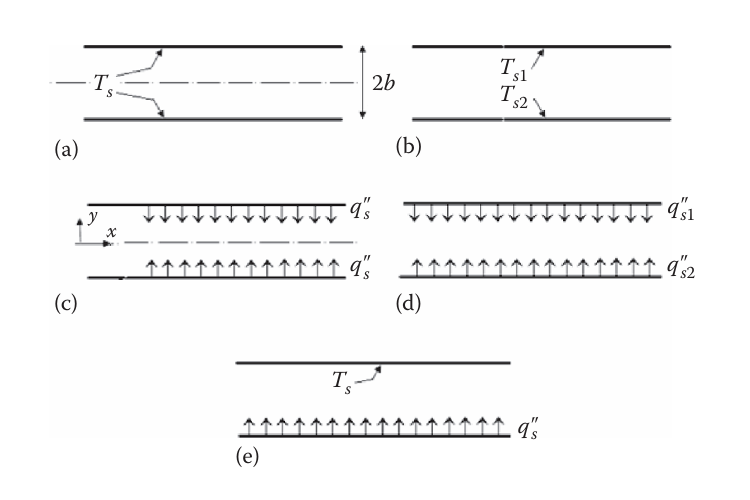
Laminar Flow
Analytical: Smooth surface, negligible axial conduction, uniform wall heat flux (Case C in Fig. 1)
\mathrm{Nu}_{D_H,\mathrm{UHF}}=\frac {140}{17}\approx8.235\tag{4.4.42}
Tyagi, (1966), Shah and London, (1978): With viscous dissipation and volumetric energy generation, if q_v^*=\frac {\dot q_vD_H}{q_s''} and \mathrm{Br}'=\frac {\mu U_m^2}{q_s''D_H}
\mathrm{Nu}_{D_H,\mathrm{UHF}}=\frac {140}{17}\frac 1{1+\frac 3{68}q_v^*+\frac {108}{17}\mathrm{Br}'}\tag{4.4.43}
Analytical: Smooth surface, negligible axial conduction, unequal and constant heat flux (Case C in Fig. 1)
\begin{aligned} \mathrm{Nu}_{D_H,1} & =\frac {140}{26-9\frac {q_{s2}''}{q_{s1}''}} \\ \mathrm{Nu}_{D_H,2} & =\frac {140}{26-9\frac {q_{s1}''}{q_{s2}''}} \end{aligned}\tag{4.4.47}
Analytical: Smooth surface, negligible axial conduction, negligible viscous dissipation, one surface constant temperature and the other constant heat flux (Case E in Fig. 1)
\begin{aligned} \mathrm{Nu}_{D_H,T} & =4 \\ \mathrm{Nu}_{D_H,q''} & =4 \end{aligned}\tag{4.4.49}
Cheng and Wu (1976): Smooth surface, axial conduction, viscous dissipation, one surface constant temperature and the other constant heat flux (Case E in Fig. 1), assume T_{s1}>T_{s2}, if \mathrm{Br}=\frac {2\mu U_m^2}{k\left[\frac 12(T_{s1}+T_{s2})-T_m\right]}
\begin{aligned} \mathrm{Nu}_{D_H,1} & =\frac {4(1-6\mathrm{Br})}{1-\frac {48}{35}\mathrm{Br}} \\ \mathrm{Nu}_{D_H,2} & =\frac {4(1+6\mathrm{Br})}{1-\frac {48}{35}\mathrm{Br}} \end{aligned}\tag{4.4.56}
Analytical: Smooth surface, negligible axial condution, uniform wall temperature (Case A in Fig. 1)
\mathrm{Nu}_{D_H,\mathrm{UWT}}=7.5407\tag{4.4.53}
Pahor and Strand (1961): Smooth surface, axial conduction, if \mathrm{Pe}=\mathrm{Re}_D\mathrm{Pr}
\mathrm{Nu}_{D_H,\mathrm{UWT}}=\begin{cases} 7.540\left(1+\frac {3.79}{\mathrm{Pe}^2}+\cdots\right) & \qquad\qquad\mathrm{Pe}\gg1 \\ 8.118(1-0.031\mathrm{Pe}+\cdots) & \qquad\qquad\mathrm{Pe}\ll1 \end{cases}
Turbulent Flow
Developed Hydrodynamic, Developing Thermal Entrance
This section covers the case where the hydrodynamic boundary layer is fully developed and the thermal boundary layer is developing. These correlations are applicable for flows where \mathrm{Pr}\gg1. For the cases of \mathrm{Pr}\eqsim1 or \mathrm{Pr}\lesssim1, see Sec. 4.4 for the appropriate correlations.
Heat Transfer Coefficient
Laminar Flow
Shah and London (1978): Smooth surface, negligible axial conduction, negligible viscous dissipation, if x^*=\frac x{D_H\mathrm{Re}_{D_H}\mathrm{Pr}}
\begin{aligned} \mathrm{Nu}_{D_H,\mathrm{UHF}}(x^*) & =\begin{cases} 1.490\left(x^*\right)^{-1/3} & \qquad x^*\leq2\times10^{-4} \\ 1.490\left(x^*\right)^{-1/3}-0.4 & \qquad2\times10^{-4}<x^*\leq10^{-3} \\ 8.235+8.68\left(x^*\times10^3\right)^{-0.506}e^{-164x^*} & \qquad x^*>10^{-3} \end{cases} \\ \langle\mathrm{Nu}_{D_H,\mathrm{UHF}}\rangle_x & =\begin{cases} 2.236\left(x^*\right)^{-1/3} & \qquad\qquad\qquad\qquad x^*\leq10^{-3} \\ 2.236\left(x^*\right)^{-1/3}+0.9 & \qquad\qquad\qquad\qquad10^{-3}<x^*\leq0.01 \\ 8.235+0.0364\left(x^*\right)^{-1} & \qquad\qquad\qquad\qquad x^*>0.01 \end{cases} \end{aligned}\tag{4.5.101}
Analytical: Smooth surface, if x^*=\frac x{D_H\mathrm{Re}_{D_H}\mathrm{Pr}}
\mathrm{Nu}_{D_H,\mathrm{UWT}}(x^*)=\frac 2{\Gamma\left(\frac 43\right)\left(6x^*\right)^{1/3}}\tag{4.5.127}
Shah and London (1978): Smooth surface, if x^*=\frac x{D_H\mathrm{Re}_{D_H}\mathrm{Pr}}
\begin{aligned} \mathrm{Nu}_{D_H,\mathrm{UWT}}(x^*) & =\begin{cases} 1.233\left(x^*\right)^{-1/3}+0.4 & \qquad x^*\leq10^{-3} \\ 7.541+6.874\left(x^*\times10^{-3}\right)^{-0.488}e^{-245x^*} & \qquad x^*>10^{-3} \end{cases} \\ \langle\mathrm{Nu}_{D_H,\mathrm{UWT}}\rangle_x & =\begin{cases} 1.849\left(x^*\right)^{-1/3} & \qquad\qquad\qquad\qquad\quad x^*\leq5\times10^{-4} \\ 1.849\left(x^*\right)^{-1/3}+0.6 & \qquad\qquad\qquad\quad\qquad5\times10^{-4}<x^*\leq0.006 \\ 7.541+0.0235\left(x^*\right)^{-1} & \qquad\qquad\qquad\qquad\quad x^*>0.006 \end{cases} \end{aligned}\tag{4.5.128}
Gnielinski (2010): Smooth surface, negligible axial conduction, negligible viscous dissipation, if x^*=\frac x{D_H\mathrm{Re}_{D_H}\mathrm{Pr}}\ll1
\begin{aligned} \langle\mathrm{Nu}_{D_H,\mathrm{UWT}}\rangle_x & =\left[\mathrm{Nu}_{D_H,\mathrm{UWT},1}^3+\mathrm{Nu}_{D_H,\mathrm{UWT},2}^3(x)\right]^{1/3} \\ \mathrm{Nu}_{D_H,\mathrm{UWT},1} & =7.5407 \\ \mathrm{Nu}_{D_H,\mathrm{UWT},2}(x) & =1.841\left(x^*\right)^{-1/3} \end{aligned}\tag{4.5.143}
Turbulent Flow
Combined Entrance Region
Heat Transfer Coefficient
Laminar Flow
Stephan (1959): Smooth surface, uniform wall temperature, if x^*=\frac x{D\mathrm{Re}_D\mathrm{Pr}}
\langle\mathrm{Nu}_{D,\mathrm{UWT}}\rangle_x=7.55+\frac {0.024(x^*)^{-1.14}}{1+0.0358\mathrm{Pr}^{0.17}(x^*)^{-0.64}}\tag{4.6.3}
Stephan (1959): Smooth surface, uniform wall temperature, if x^*=\frac x{D\mathrm{Re}_D\mathrm{Pr}}
\mathrm{Nu}_{D,\mathrm{UWT}}(x^*)=7.55+\frac {0.024(x^*)^{-1.14}\left[0.0179\mathrm{Pr}^{0.17}(x^*)^{-0.64}-0.14\right]}{\left[1+0.0358\mathrm{Pr}^{0.17}(x^*)^{-0.64}\right]^2}\tag{4.6.4}
Turbulent Flow
Concentric Annular Duct
Fully Developed Flow
Profiles
Hagen-Poiseuille (1840): Smooth surface, if R_i and R_0 are the inner and outer radii respectively
u(r)=\left[R_0^2-r^2+(R_0^2-R_i^2)\frac {\ln\left(r/R_0\right)}{\ln\left(R_0/R_i\right)}\right]\left(-\frac 1{4\mu}\frac {\mathrm dP}{\mathrm dx}\right)\tag{4.3.31}
General Geometries
Friction Factor
Laminar Flow
Muzychka and Yovanovich (2004): Smooth surface, dimensionless distance defined as x^*=\frac x{\sqrt A\mathrm{Re}_{\sqrt A}}, accurate to within \pm10\%
C_{f,\mathrm{app},x}\mathrm{Re}_{\sqrt A}=\sqrt{\left(\frac {12}{\sqrt{\alpha^*}(1+\alpha^*)\left[1-\frac {192\alpha^*}{\pi^5}\tanh\left(\frac {\pi}{2\alpha^*}\right)\right]}\right)^2+\left(\frac {3.44}{\sqrt{x^*}}\right)^2}\tag{4.2.17}
Heat Transfer Coefficient
Laminar Flow
Muzychka and Yovanovich (2004): Smooth surface, both uniform wall temperature and uniform heat flux, if x^*=\frac x{\sqrt A\mathrm{Re}_{\sqrt A}\mathrm{Pr}}
\mathrm{Nu}_{\sqrt A}=\left[\left(\frac {C_ff(\mathrm{Pr})}{\sqrt{x^*}}\right)^m+\left(\left[C_2C_3\left(\frac {C_f\mathrm{Re}_{\sqrt A}}{x^*}\right)^{1/3}\right]^5+\left(\frac {C_1C_f\mathrm{Re}_{\sqrt A}}{8\sqrt{\pi}(\alpha^*)^{\gamma}}\right)^5\right)^{m/5}\right]^{1/m}\tag{4.6.5}
where the blending parameter, m, and Fanning friction factor, C_f, are
\begin{aligned} m & =2.27+1.65\mathrm{Pr}^{1/3} \\ C_f\mathrm{Re}_{\sqrt A} & =\frac 12{\sqrt{\alpha^*}(1+\alpha^*)\left[1-\frac {192\alpha^*}{\pi^5}\tanh\left(\frac {\pi}{2\alpha^*}\right)\right]} \end{aligned}\tag{4.6.7}
The aspect ratio, \alpha^*, is defined in . The shape factor, \gamma, varies from -\frac 3{10}\leq\gamma\leq\frac 1{10}. For rectangular and ellipsoid channels, \gamma=\frac 1{10}. For rhombus, isosceles, and right triangles, \gamma=-\frac 3{10}. The correlation is accurate to within \pm25\%.