MAT 266 Section 7.4 Homework
Introduction
The arc length of any continuous and smooth (no discontinuities) function can be determined by dividing up the interval a\leq x\leq b into n equal subintervals each with width \Delta x. An example of a random function is given below, divided into n=9 subintervals.
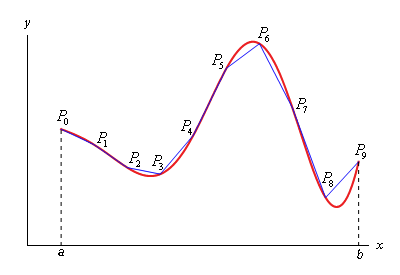
Let’s take a look at any line segment, P_4 to P_5 for instance. By the Pythagorean theorem, the length of the line segment L_4 is simply the hypotenuse of the right triangle of horizontal width \Delta x and vertical height \Delta y. The lengths can be calculated from the x and y coordinates of the function. With points P_4 and P_5 for instance, the horizontal and vertical lengths are
\begin{aligned} \Delta x & =x_5-x_4 \\ \Delta y_4 & =y_5-y_4 \end{aligned}
For the right triangle then, the approximate arc length L_4 is
L_4=\sqrt{\Delta x^2+\Delta y_4^2}=\sqrt{(x_5-x_4)^2+(y_5-y_4)^2}
The change in y is annoying - how can we somehow rewrite this in terms of change in x? The answer is through the mean value theorem.
The mean value theorem simply states that if f(x) is a function that is both
Continuous on the interval a\leq x\leq b
Differentiable on the interval a<x<b
Then there exists a number c between a<c<b where
f'(c)=\frac {f(b)-f(a)}{b-a} \tag{1}
Rewriting Eq. 1 as a line in point-slope form, then
f(b)-f(a)=f'(c)(b-a) \tag{2}
Using Eq. 2 allows us to rewrite \Delta y_4 in terms of \Delta x. Since the theorem only guarantees that a point will exist (i.e., the actual value of the point is still unknown), let c_4 be this special point. From the Mean Value Theorem, then
f(x_5)-f(x_4)=f'(c_4)(x_5-x_4)=f'(c_4)\Delta x
Therefore, the length, L_4, can be written as
\begin{aligned} L_4 & =\sqrt{(x_5-x_4)^2+(y_5-y_4)^2}=\sqrt{\Delta x^2+\left[f'(c_4)\right]^2\Delta x^2}=\Delta x\sqrt{1+\left[f'(c_4)\right]^2} \end{aligned}
Of course, there is nothing special about the points P_4 and P_5. In fact, we can extend this to any point x_k where 0\leq k\leq n-1. In general, for any k value within that range, the estimated arc length, L_k, is
L_k=\Delta x\sqrt{1+\left[f'(c_k)\right]^2}
If we sum up all the contributions of L_k, then we should get a value that is close to the function’s arc length. That is, in Fig. 1, if we sum up L_0+L_1+\ldots+L_8, then we should have a somewhat reasonable approximation for the length of f(x) between x\in[a, b].
L\approx L_0+L_1+L_2+\cdots+L_{n-1}=\sum\limits_{k=0}^{n-1}L_k=\sum\limits_{k=0}^{n-1}\Delta x\sqrt{1+\left[f'(c_k)\right]^2} \tag{3}
This accuracy will obviously improve as the number of rectangles, n, increases. As the width of each subinterval, \Delta x, becomes infinitesimally small, the error between each line segment L_k and the actual arc of the function f(x) will get smaller as well. As a result, the approximation in Eq. 3 becomes an exact equality as n\to+\infty. This is where the integral comes into play: we are summing the infinitesimally small subintervals between a\leq x\leq b that calculate the arc length of f(x) at each interval.
L=\lim\limits_{n\to+\infty}\sum\limits_{k=0}^{n-1}\sqrt{1+\left[f'(c_k)\right]^2}\Delta x=\int\limits_a^b\sqrt{1+\left[f'(x)\right]^2}\,\mathrm dx
A more convenient way of writing the arc length formula is in terms of f'(x)=\frac {\mathrm dy}{\mathrm dx}. Furthermore, the same process above can be applied to a function x=g(y) between the interval c\leq y\leq d. Use this other formula if the problem gives the function as x in terms of y (e.g., x=y^2+\sqrt y).
\begin{aligned} L & =\int\limits_a^b\sqrt{1+\left(\frac {\mathrm dy}{\mathrm dx}\right)^2}\,\mathrm dx \\ L & =\int\limits_c^d\sqrt{1+\left(\frac {\mathrm dx}{\mathrm dy}\right)^2}\,\mathrm dy \end{aligned} \tag{4}
Problem 1
Problem: Which of the following integrals represents the length of the curve y=\cos x for 0\leq x\leq2\pi?
\displaystyle\int\limits_0^{2\pi}\sqrt{1+\sin x}\,\mathrm dx
\displaystyle\int\limits_0^{2\pi}\sqrt{1+\cos x}\,\mathrm dx
\displaystyle\int\limits_0^{2\pi}\sqrt{1-\cos^2x}\,\mathrm dx
\displaystyle\int\limits_0^{2\pi}\sqrt{1+\cos^2x}\,\mathrm dx
\displaystyle\int\limits_0^{2\pi}\sqrt{1-\sin^2x}\,\mathrm dx
\displaystyle\int\limits_0^{2\pi}\sqrt{1+\sin^2x}\,\mathrm dx
Answer: Since y is given in terms of x, we should integrate across x for the arc length. If y=\cos x, then \frac {\mathrm dy}{\mathrm dx}=-\sin x, so
\int\limits_0^{2\pi}\sqrt{1+\left(\frac {\mathrm dy}{\mathrm dx}\right)^2}\,\mathrm dx=\int\limits_0^{2\pi}\sqrt{1+\sin^2 x}\,\mathrm dx
Therefore, the answer is F.
Problem 2
Problem: Which of the following integrals represents the length of the curve x=y+y^3 for 1\leq y\leq4?
\displaystyle\int\limits_1^4\sqrt{1+(1+5y^4)^2}\,\mathrm dy
\displaystyle\int\limits_1^4\sqrt{1+(1+y^2)^2}\,\mathrm dy
\displaystyle\int\limits_1^4\sqrt{1+(1+3y^2)^2}\,\mathrm dy
\displaystyle\int\limits_1^4\sqrt{1+(1+2y)^2}\,\mathrm dy
\displaystyle\int\limits_1^4\sqrt{1+(1+y^3)^2}\,\mathrm dy
\displaystyle\int\limits_1^4\sqrt{1+(1+4y^3)^2}\,\mathrm dy
Answer: Since x is given in terms of y, we should integrate across y. If x=y+y^3, then \frac {\mathrm dx}{\mathrm dy}=1+3y^2. Therefore
\int\limits_c^d\sqrt{1+\left(\frac {\mathrm dx}{\mathrm dy}\right)^2}\,\mathrm dy=\int\limits_1^4\sqrt{1+(1+3y^2)^2}\,\mathrm dy
Therefore, the answer is C.
Problem 3
Problem: To find the length of the curve defined by y=4x^6+7x from (0,0) to (4,16412), you’d have to compute
\int\limits_a^bf(x)\,\mathrm dx
What are a, b, and f(x)?
Answer: Since y is given as a function of x, we should integrate across x. The range of x values to consider is 0\leq x\leq4 from the problem. The derivative is \frac {\mathrm dy}{\mathrm dx}=24x^5+7 from the power rule. Putting everything together, then
L=\int\limits_0^4\sqrt{1+(24x^5+7)^2}\,\mathrm dx
Therefore, a=0, b=4, and f(x)=\sqrt{1+(24x^5+7)^2}.
Problem 4
Problem: Given the equation xy=30, set up the integral to find the length of the path from a\leq x\leq b and enter the integrand.
Answer: The function given does not explicitly express y as a function of x or vice versa. In fact, we can easily solve for one variable and express it as a function of the other variable. For instance, if we divide both sides by x, then y=\frac {30}x and we can express y as a function of x. However, we could have just as easily divided by sides by y so x=\frac {30}y and express x as a function of y. For this problem, it does not matter which we choose. However, since the x range is given as a\leq x\leq b, we should probably integrate across x.
Since y=\frac {30}x, then \frac {\mathrm dy}{\mathrm dx}=-\frac {30}{x^2} from the power rule. Therefore, the integrand (portion that is enclosed by the integral) is
\sqrt{1+\left(\frac {\mathrm dy}{\mathrm dx}\right)^2}=\sqrt{1+\left(-\frac {30}{x^2}\right)^2}=\sqrt{1+\frac {900}{x^4}}
Problem 5
Problem: Find the arc length formed by y=\frac 18\left(-2x^2+4\ln x\right) from 2\leq x\leq5.
Answer: Since y is given in terms of x, we should integrate across x (i.e., use the first equation in Eq. 4). Using the fact that the derivative of x^n is nx^{n-1}, and that the derivative of \ln x is \frac 1x, the derivative of y(x) is
\frac {\mathrm dy}{\mathrm dx}=-\frac x2+\frac 1{2x}=\frac 12\left(\frac 1x-x\right)
The arc length is
L=\int\limits_2^5\sqrt{1+\left[\frac 12\left(\frac 1x-x\right)\right]^2}\,\mathrm dx=\int\limits_2^5\sqrt{1+\frac 14\left(\frac 1x-x\right)^2}\,\mathrm dx
This integral may seem difficult, but note that if the binomial \left(\frac 1x-x\right)^2 is expanded, then
\left(\frac 1x-x\right)^2=\frac 1{x^2}-2+x^2=\frac {x^4+1}{x^2}-2
Substituting this into the integral gives
L=\int\limits_2^5\sqrt{1+\frac 14\left(\frac {x^4+1}{x^2}-2\right)}\,\mathrm dx=\int\limits_2^5\sqrt{\frac {x^4+1}{4x^2}+\frac 12}=\int\limits_2^5\sqrt{\frac {x^4+2x^2+1}{4x^2}}\,\mathrm dx
The expression inside the square root can be written as a single square.
\sqrt{\frac {x^4+2x^2+1}{4x^2}}=\sqrt{\frac {(x^2+1)^2}{4x^2}}=\frac {x^2+1}{2x}
Therefore, the integral reduces down to
L=\int\limits_2^5\frac {x^2+1}{2x}\,\mathrm dx=\frac 12\left[\int\limits_2^5 x\,\mathrm dx+\int\limits_2^5\frac {\mathrm dx}x\right]=\frac {21}4+\frac 12\ln\left(\frac 52\right)
Problem 6
Problem: Find the exact length of the curve y=\frac {x^3}6+\frac 1{2x} for \frac 12\leq x\leq 1.
Answer: The derivative is \frac {\mathrm dy}{\mathrm dx}=\frac {x^2}2-\frac 1{2x^2}=\frac 12\left(x^2-\frac 1{x^2}\right). The integrand is of the arc length formula is
\sqrt{1+\left(\frac {\mathrm dy}{\mathrm dx}\right)^2}=\sqrt{1+\frac 14\left(\frac {x^4-1}{x^2}\right)^2}=\sqrt{\frac {4x^4+(x^4-1)^2}{4x^4}}=\sqrt{\frac {x^8+2x^4+1}{4x^4}}=\sqrt{\frac {(x^4+1)^2}{4x^4}}=\frac {x^4+1}{2x^2}=\frac {x^2+x^{-2}}2
Therefore, integrating and using the power rule for antiderivatives gives
L=\frac 12\int\limits_{1/2}^1x^2+x^{-2}\,\mathrm dx=\frac {31}{48}
Problem 7
Problem: Find the length of the curve y=3x^{3/2}-7 from 2\leq x\leq 9.
Answer: The derivative is \frac {\mathrm dy}{\mathrm dx}=\frac 92x^{1/2} via the power rule: (x^n)'=nx^{n-1}. Therefore
L=\int\limits_2^9\sqrt{1+\left(\frac {\mathrm dy}{\mathrm dx}\right)^2}\,\mathrm dx=\int\limits_2^9\sqrt{1+\frac {81x}4}\,\mathrm dx
This integral might seem complicated at first, but note that it’s just the square root of a linear term. It would be a lot easier to integrate something like \sqrt u rather than \sqrt{1+\frac {81x}4}. Therefore, we can use u-substitution to recast the integral into a simple power rule. Let u=1+\frac {81x}4 so \mathrm du=\frac {81}4\,\mathrm dx. Then
L=\frac 4{81}\int\limits_{41.5}^{183.25}u^{1/2}\,\mathrm du=\frac {733^{3/2}-166^{3/2}}{243}
Problem 8
Problem: Find the length of the curve x=\frac 13\sqrt y(y-3) from 1\leq y\leq 9.
Answer: Since x is given in terms of y, we should use the second equation in Eq. 4. Since y=\frac 13y^{3/2}-y^{1/2}, then the derivative is \frac {\mathrm dx}{\mathrm dy}=\frac 12y^{1/2}-\frac 12y^{-1/2}=\frac 12\left(y^{1/2}-y^{-1/2}\right). The integrand is
\sqrt{1+\left(\frac {\mathrm dx}{\mathrm dy}\right)^2}=\sqrt{1+\frac 14\left(\frac {y-1}{y^{1/2}}\right)^2}=\sqrt{\frac {4y+(y-1)^2}{4y}}=\frac {y+1}{2\sqrt y}=\frac {y^{1/2}+y^{-1/2}}2
Integrate this to get
L=\frac 12\int\limits_1^9y^{1/2}+y^{-1/2}\,\mathrm dy=\frac 12\left.\left(\frac 23y^{3/2}+2\sqrt y\right)\right|_1^9=\frac {32}3