Design Procedure of a Moveable Pintle Injector for LREs
The design parameters for a throttling gas-liquid pintle injector are shown in Fig. 1. Three different pintle tips were tested with different tip angles, \theta_{\mathrm{pt}}, in this paper. The post angle, \theta_{\mathrm{post}}, was fixed to be 30°.
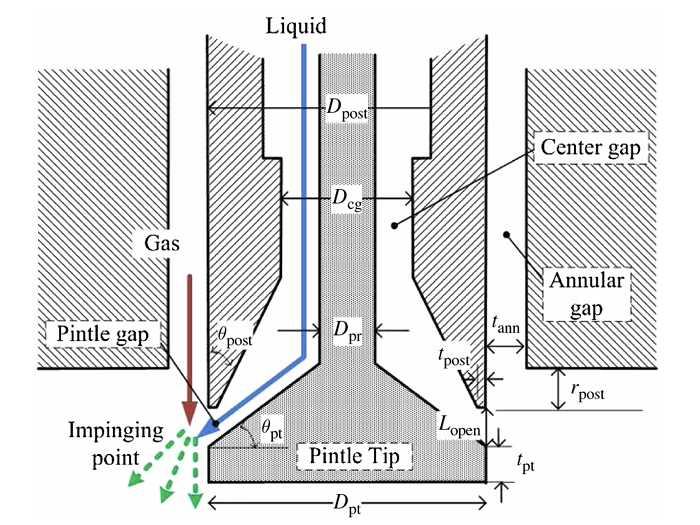
Since \theta_{\mathrm{post}} is sufficiently small, the minimum orifice area for the liquid flow always occurred at the post tip. For larger values of \theta_{\mathrm{post}} relative to \theta_{\mathrm{pt}}, the minimum cross-sectional area may occur further upstream. This is an important design factor to consider, as if the minimum orifice area in the pintle changes, so does the discharge coefficient.
The minimum orifice area, A_{\mathrm{min}}, can be calculated using
A_{\mathrm{min}}=\frac {\pi}{\sin\theta_{\mathrm{pt}}}\left[\left(R_{\mathrm{post}}-t_{\mathrm{post}}\right)^2-\left(R_{\mathrm{post}}-t_{\mathrm{post}}-L_{\mathrm{open}}\sin\theta_{\mathrm{pt}}\cos\theta_{\mathrm{pt}}\right)^2\right] \tag{1}
As the throttle increases and L_{\mathrm{open}} increases, A_{\mathrm{min}} increases as well. At some point during the throttle, however, the minimum orifice area will be equal to the center gap area, A_{\mathrm{cg}}, which is a constant set by the design of the pintle. After this transition point, the minimum orifice area is now A_{\mathrm{cg}} and remains constant throughout the rest of the throttle.